I’m an interface and information designer working at the intersection of design, data and code. I specialise in crafting interactive experiences, digital tools and visual stories that help people navigate complex information.
selected activities

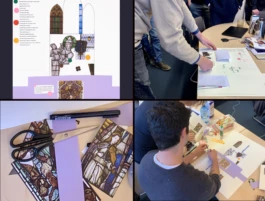
I challenged the TELOTA team at the BBAW, who specialise in digital tools, through an analogue data collage exercise for one of their cultural collection projects. Drawing on methods from my research at UCLAB, the workshop combined data vis principles, design, and coding with d3.
The workshop addressed a main challenge in their work: creating not only single data visualisations but visual systems and tools that enable users to explore complex cultural collections. While some were initially hesitant to work analogue, the exercise quickly showed how stepping away from purely digital workflows can lead to interesting approaches. Those who were most reserved at the beginning went on to develop unexpected, exploratory and even three-dimensional interface concepts. The results served as a discussion basis and opened up new perspectives on how to guide users trough their collections.
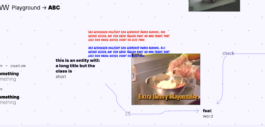
The second part focused on experimenting with d3.js to translate these ideas into interactive visualisations.

I participated in a panel discussion with Jutta von Allmendinger, Lena Hipp and David Skopec for the 10-year anniversary of the Visual Society Program, a collaboration between the WZB Berlin Social Science Center and the Berlin University of the Arts (UdK). Eight years after taking part in the program as a student, I returned as a panelist to reflect on interdisciplinary collaboration and the potential of bringing together social scientists and designers to develop new approaches for visually communicating social research.

As part of the Amazonia Future Lab Project we showed our two-screen installation “Xingu Entangled” at the re:publica 24, which explored the challenges of the future that require a society characterised by solidarity and civic engagement. With our installation, we illustrated the potential of collaboration between science, design practice and indigenous knowledge. And asked: How can we overcome artefact-centric museum practices and disciplinary boundaries to adequately represent indigenous perspectives?
Img: ©Fidel Thomet

Results from the research project Amazonia Future Lab were shown as part of the exhibition Existência Numérica in Rio de Janeiro. Indigenous perspectives on the interdependencies between humans and the environment are made visible in the form of the video installation Xingu Entangled, which combines documentary film footage with interactive visualisations.
Img: ©Fidel Thomet

Together with Viktoria Brüggemann, we held a workshop for participants from the Freie Universität Berlin as part of the “Digital Storytelling in Classical Studies” program by Prof. Elisa Roßberger. We addressed important ethical questions related to working with data and presented tools and activities on the topics of data visualization and data storytelling.

Together with Fidel Thomet, I taught the semester course “Entanglements”, focusing on visualising and narrating complex systems. Students explored relationships between human and non-human actors and developed non-linear storytelling approaches to communicate complex interdependencies. Working experimentally with data, video, sound, and images, they created interactive video installations. The course introduced methods in data visualisation and visual storytelling.
Img: ©Fidel Thomet

Information+ is an interdisciplinary conference that brings together researchers, educators, and practitioners in information design and data visualization.
In the exhibition, we used our framework’s presentation features to display contextualized data in combination with videos. The result was a two-channel installation where visitors could navigate different knowledge networks, along with documentary films on myths from the Xingu region.
I’m an interface and information designer working at the intersection of design, data and code. I specialise in crafting interactive experiences, digital tools and visual stories that help people navigate complex information.
projects
selected activities

I challenged the TELOTA team at the BBAW, who specialise in digital tools, through an analogue data collage exercise for one of their cultural collection projects. Drawing on methods from my research at UCLAB, the workshop combined data vis principles, design, and coding with d3.
The workshop addressed a main challenge in their work: creating not only single data visualisations but visual systems and tools that enable users to explore complex cultural collections. While some were initially hesitant to work analogue, the exercise quickly showed how stepping away from purely digital workflows can lead to interesting approaches. Those who were most reserved at the beginning went on to develop unexpected, exploratory and even three-dimensional interface concepts. The results served as a discussion basis and opened up new perspectives on how to guide users trough their collections.
The second part focused on experimenting with d3.js to translate these ideas into interactive visualisations.

I participated in a panel discussion with Jutta von Allmendinger, Lena Hipp and David Skopec for the 10-year anniversary of the Visual Society Program, a collaboration between the WZB Berlin Social Science Center and the Berlin University of the Arts (UdK). Eight years after taking part in the program as a student, I returned as a panelist to reflect on interdisciplinary collaboration and the potential of bringing together social scientists and designers to develop new approaches for visually communicating social research.

As part of the Amazonia Future Lab Project we showed our two-screen installation “Xingu Entangled” at the re:publica 24, which explored the challenges of the future that require a society characterised by solidarity and civic engagement. With our installation, we illustrated the potential of collaboration between science, design practice and indigenous knowledge. And asked: How can we overcome artefact-centric museum practices and disciplinary boundaries to adequately represent indigenous perspectives?
Img: ©Fidel Thomet

Information+ is an interdisciplinary conference that brings together researchers, educators, and practitioners in information design and data visualization.
In the exhibition, we used our framework’s presentation features to display contextualized data in combination with videos. The result was a two-channel installation where visitors could navigate different knowledge networks, along with documentary films on myths from the Xingu region.

Together with Viktoria Brüggemann, we held a workshop for participants from the Freie Universität Berlin as part of the “Digital Storytelling in Classical Studies” program by Prof. Elisa Roßberger. We addressed important ethical questions related to working with data and presented tools and activities on the topics of data visualization and data storytelling.

Together with Fidel Thomet, I taught the semester course “Entanglements”, focusing on visualising and narrating complex systems. Students explored relationships between human and non-human actors and developed non-linear storytelling approaches to communicate complex interdependencies. Working experimentally with data, video, sound, and images, they created interactive video installations. The course introduced methods in data visualisation and visual storytelling.
Img: ©Fidel Thomet

Information+ is an interdisciplinary conference that brings together researchers, educators, and practitioners in information design and data visualization.
In the exhibition, we used our framework’s presentation features to display contextualized data in combination with videos. The result was a two-channel installation where visitors could navigate different knowledge networks, along with documentary films on myths from the Xingu region.