video: Ambos &&
RESEARCH PROJECT AT UCLAB SEE PROTOTYPE PAPER VISIT WEBSITE
A clay pot in an ethnological museum tells one story. The botanist's records on the plant used in the manufacturing process tell another. The spiritual narrative of the community who made the pot tells a third. In Western institutions, these threads are kept apart, sorted by discipline, and stored in separate buildings. But for the indigenous communities of the Upper Xingu south of the Amazon River, a fish trap is not just an artefact. It connects a specific plant, a geographical distribution, a manufacturing process, a ritual, and a spiritual meaning into a single network.
Xingu Entangled is an interactive data installation that recontextualises Xingu artefacts by weaving objects, plants, rituals, and places into narratives. Rather than merely learning about physical objects, it surface their complex interrelationships with the support of video clips and interactive networks.
role
visual design and visual storytelling,
data processing,
user testing,
concept & research
team
Fidel Thomet, Marian Dörk,
Andrea Scholz, Flavia Heins,
Thiago da Costa Oliveira
partner
Indigenous communities from the Upper Xingu and the Rio Negro,
Ethnologisches Museum Berlin,
Botanischer Garten Berlin,
Museu Nacional Rio de Janeiro,
Ibero-Amerikanisches Institut
year
2020 – 2024
context
Xingu Entangled is the first case study of the Amazonia Future Lab, developed with an interdisciplinary team of designers, ethnologists, curators, botanists, and indigenous representatives from the Xingu community.
The projects starting point were objects like a stool or a fish trap, which are at once a cultural artefact, made from a plant the botanist maps and studies, and a spiritual actor for the Xingus. Which led to a central question:
How do you bring fundamentally different ways of understanding the world into a single experience and let people follow the stories and trace the connections for themselves?
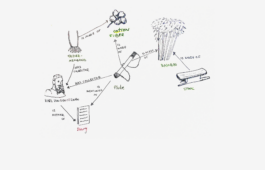
The sketches below explore how to visualise these different perspectives in a graph.


process
The first instinct was to represent connections through network structures and use standardized vocabularies to ensure consistency. However, user testing revealed: the language was too abstract and forcing Xingu knowledge into existing classification systems meant flattening exactly what we were trying to preserve. At the same time, algorithmically generated network layouts made it difficult to represent processes such as production and ritual practices in a clear and engaging way.
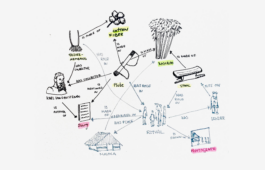
We therefore shifted from pure networks to a combination of both: interactive flowcharts that guide you through a single story, and networks that reveal the connections between them.
The images below show this progression in our early prototypes.

outcome
Xingu entangled is a interactive web application and has been exhibited at several international venues including at the re:publica 24 Berlin, the Humboldt Forum Berlin, the Info+ Conference 23 Edinburgh and at Existência Numérica 24 Rio de Janeiro.
Xingu Entangled shows videos with scenes from the Xingu, while the visualization displays elements appearing in the current scene and their interconnections in a diagram. As the scenes unfold, so do their associated flowchart by uncovering and highlighting elements. The interactivity allows to break out of the default linear narrative and navigate between scenes, as well as to learn more about specific elements and their wider contexts.
The installation is part of a larger framework – the Wanderer – that allows data production and coupling it to film media.


RESEARCH PROJECT AT UCLAB
PROTOTYPE PAPER PROJECT WEBSITE
A clay pot in an ethnological museum tells one story. The botanist's records on the plant used in the manufacturing process tell another. The spiritual narrative of the community who made the pot tells a third. In Western institutions, these threads are kept apart, sorted by discipline, and stored in separate buildings. But for the indigenous communities of the Upper Xingu south of the Amazon River, a fish trap is not just an artefact. It connects a specific plant, a geographical distribution, a manufacturing process, a ritual, and a spiritual meaning into a single network.
Xingu Entangled is an interactive data installation that recontextualises Xingu artefacts by weaving objects, plants, rituals, and places into narratives. Rather than merely learning about physical objects, it surface their complex interrelationships with the support of video clips and interactive networks.
role
visual design and visual storytelling,
data processing,
user testing,
concept & research
team
Fidel Thomet, Marian Dörk,
Andrea Scholz, Flavia Heins,
Thiago da Costa Oliveira
partner
Indigenous communities from the Upper Xingu and the Rio Negro,
Ethnologisches Museum Berlin,
Botanischer Garten Berlin,
Museu Nacional Rio de Janeiro,
Ibero-Amerikanisches Institut
year
2020 – 2024
context
Xingu Entangled is the first case study of the Amazonia Future Lab, developed with an interdisciplinary team of designers, ethnologists, curators, botanists, and indigenous representatives from the Xingu community.
The projects starting point were objects like a stool or a fish trap, which are at once a cultural artefact, made from a plant the botanist maps and studies, and a spiritual actor for the Xingus. Which led to a central question:
How do you bring fundamentally different ways of understanding the world into a single experience and let people follow the stories and trace the connections for themselves?
The sketches below explore how to visualise these different perspectives in a graph.