Departing from historical-ethnographic and botanical collections from and about the Brazilian Amazon region, the intercultural and interdisciplinary research project shifted the focus from the discrete artefact to the relational context of its manufacturing process, its usage or its significance within traditional rituals.
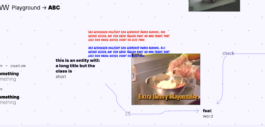
Within the project, the Wanderer was developed—a framework for creating non-linear, interactive narratives intended for both exhibitions and the web. It enables the contextualisation of data within a graph of meaningful relationships, making these connections both navigable and narratable. The software provides an interface for producing and linking data with film media, as well as for presenting this information to audiences.
Tasks
UX/UI Design, Prototyping, User testing, Data processing, Concept & Research
Collaborators
Fidel Thomet, Marian Dörk, Andrea Scholz, Thiago da Costa Oliveira, Flavia Heins
Partner
Ethnologisches Museum Berlin, Fachhochschule Potsdam, Botanischer Garten Berlin, Muesu Nacional Rio de Janeiro, Ibero-Amerikanisches Institut
Visit project website
Use the Wanderer software

Xingu Entangled is an interactive video exhibit documenting material practices and knowledges from the indigenous communities of the Upper Xingu. By weaving objects, places, events, organisms, and spiritual actors into non-linear narratives and data structures, Xingu Entangled surfaces their complex interrelations. By emphasising boundary objects over physical artefacts, it bridges disciplinary domains and effectively communicates manifold perspectives. The interactive capacity of the two-channel installation invites visitors to explore the possibilities of user-guided navigation along the data relations and video clips, while also offering situated storytelling with voices and perspectives from the Xingu community.
The installation is the first case study of the Amazonia Future Lab implemented with the Wanderer software. It aimes at illustrating the potential for collaboration between academia, design practice, and indigenous knowledge.
Tasks
Visual Design, Prototyping, User testing, Data processing, Concept & Research
Collaborators
Fidel Thomet, Marian Dörk, Andrea Scholz, Thiago da Costa Oliveira, Flavia Heins
Partner
Indigenous communities from the Upper Xingu and the Rio Negro, Ethnologisches Museum Berlin, Fachhochschule Potsdam, Botanischer Garten Berlin, Muesu Nacional Rio de Janeiro, Ibero-Amerikanisches Institut
Visit project website
Visit Xingú Entangled


The SENSES project aims at making climate change scenarios more accessible, understandable and actionable by creating innovative data visualisations and data narratives. Instrumental for this is the SENSES Toolkit, an evolving web platform that bridges the gap between a basic knowledge of climate change and an in-depth understanding of climate change scenarios. We specifically address demands from both policy and finance audiences.
Tasks
UX/UI Design, Visual Design, Prototyping,
User testing, Concept & Research
Collaborators
Katja Dittrich, Jonas Parnow, Fidel Thomet, Boris Müller, Francesca Morini et al.
Partners
Fachhochschule Potsdam, Potsdam-Institut für Klimafolgenforschung, International Institute for Applied Systems Analysis, Stockholm Environment Institute, Wageningen University


The Transition Risks modules are part of the Senses toolkit and explore pathways toward a low-carbon future. Collaborating closely with a climate scientists, we developed three data-driven modules that transform complex climate data into accessible, interactive experiences.
Tasks
Development, Data Visualisation, Data processing, Storytelling
Collaborators
Bas van Ruijven, Jihoon Min, Francesca Morini and Jonas Parnow
Partners
Fachhochschule Potsdam, Potsdam-Institut für Klimafolgenforschung, International Institute for Applied Systems Analysis


The ID+Lab explores the structures of interdisciplinary cooperation in order to better understand, visualize and test them. Within the project we developed a platform for semantic research contextualisation.
Tasks
Visual Design, UX/UI Design, Prototyping, Ontology, Research
Collaborators
Anika Schultz, Christian Stein, Michael Dürfeld, Benjamin Thomack and Wolfgang Schäffner


Who takes care of grandma? The need for paid care is growing however, employment in the home care sector is precarious. In this project, I worked with social scientists that conducted a survey with home care workers. The goal was to collaboratively develop formats to make social contexts visible and understandable. We developed the VR application "Hard to reach" in which the user is taken “by the hand” by the scientist to make the study tangible and comprehensible through visualisation and storytelling. We focused on communicating not only the results, but especially the scientific process with its methods and challenges.
Tasks
Development, Visual Design, Storytelling, Prototyping, Concept & Research
Collaborators
Gabriela Kapfer, Lena Hipp, Sandra Leumann, Ulrich Kohler
Context
The project is part of the Visual Society Program, a collaboration between the Berlin University of the Arts and the Berlin Social Science Center.


As part of the above mentioned research project "Who takes care of grandma?" by the Berlin Social Science Center we developed an animation video that was used during the surveys with home care workers to help the interviewed persons understand the procedure of the survey.
Tasks
Animation Design, Visual Design, Storytelling
Collaborator
Gabriela Kapfer, Lena Hipp, Sandra Leumann, Ulrich Kohler
Context
The project is part of the Visual Society Program, a collaboration between the Berlin University of the Arts and the Berlin Social Science Center.


With the support of degrowth activists, I developed the concept and branding for the degrowth online magazine Elephants & Snails in my bachelor thesis. The current economic and social paradigm is “faster, higher, further“. Degrowth focuses on a reduction of production and consumption in the global North, social changes and the creation of open, connected and localized economies. The goal of the site is to increase the visibility of ideas that support Degrowth in Berlin. Users can look for interesting projects in their surroundings and are encouraged to get involved. Infographics are used within articles to explain complex topics in a fun and encouraging way.
Tasks
UX/UI Design, Visual Design, Infographic design, Concept & Research
Context
Berlin University of the Arts


How much information is needed to describe a place? The center of Berlin has a geographical significance, but it is certainly not an interesting site. At least not at first glance. I divided an area of 10x10 m around the center into 100 squares and collected information such as temperature, soil moisture, number of cigarette butts, sound level, etc. The result: 100 data visualizations of the measured values, which can be combined in different ways to create a seemingly infinite number of detailed maps of the center of Berlin. Of these, 9 were selected and printed as silkscreen prints.
Tasks
Data Visualisation, Silkscreen Printing, Concept & Research
Context
Berlin University of the Arts


selected activities

I participated in a panel discussion marking the 10-year anniversary of the Visual Society Program — a collaboration between the WZB Berlin Social Science Center and the Berlin University of the Arts (UdK). The discussion explored interdisciplinary collaboration and the potential of bringing together social scientists and designers to develop innovative approaches for visually communicating social research.

As part of the Amazonia Future Lab Project we showed our two-screen installation "Xingu Entangled" at the re:publica 24, which, under the motto "Who cares?", explored the challenges of the future that require a society characterised by solidarity and civic engagement. With our installation, we illustrated the potential of collaboration between science, design practice and indigenous knowledge. And asked: How can we overcome artefact-centric museum practices and disciplinary boundaries to adequately represent indigenous perspectives?
Img: ©Fidel Thomet

Results from the research project Amazonia Future Lab are being shown internationally as part of the exhibition Existência Numérica in Rio de Janeiro. Indigenous perspectives on the interdependencies between humans and the environment are made visible in the form of the video installation Xingu Entangled, which combines documentary film footage with interactive visualisations. In its second edition, “Existência Numérica” is being hosted by the cultural center “Futuros - Arte e Tecnologia”, in Rio de Janeiro. Curated by Barbara Castro, Doris Kosminsky and Luiz Ludwig, the exhibition dwells upon the complexity of data visualization and its applications in the world of visual arts.
Img: ©Fidel Thomet

Together with Viktoria Brüggemann, we held a workshop for participants from the Freie Universität Berlin as part of the "Digital Storytelling in Classical Studies" program by Prof. Elisa Roßberger. We addressed important ethical questions related to working with data and presented tools and activities on the topics of data visualization and data storytelling.

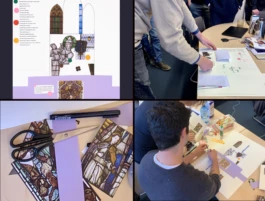
Fidel Thomet and I gave a semester course on visualising and narrating complex systems. Students investigated entanglements between human and non-human actors, using non-linear storytelling to communicate complex interdependencies. Through experimental work with data, video, sound, and images, participants created interactive video installations. The course introduced methods in data visualization, narration and prototyping.
Img: ©Fidel Thomet

Information+ is an interdisciplinary conference that brings together researchers, educators, and practitioners in information design and data visualization to discuss common questions and challenges in these rapidly changing fields. In the exhibition, we used our framework’s presentation features to display contextualized data in combination with videos. The result was a two-channel installation where visitors could navigate different knowledge networks, along with documentary films on myths from the Xingu region.

Departing from historical-ethnographic and botanical collections from and about the Brazilian Amazon region, the intercultural and interdisciplinary research project shifted the focus from the discrete artefact to the relational context of its manufacturing process, its usage or its significance within traditional rituals.
Within the project, the Wanderer was developed—a framework for creating non-linear, interactive narratives intended for both exhibitions and the web. It enables the contextualisation of data within a graph of meaningful relationships, making these connections both navigable and narratable. The software provides an interface for producing and linking data with film media, as well as for presenting this information to audiences.
Tasks
UX/UI Design, Prototyping, User testing, Data processing, Concept & Research
Collaborators
Fidel Thomet, Marian Dörk, Andrea Scholz, Thiago da Costa Oliveira, Flavia Heins
Partner
Ethnologisches Museum Berlin, Fachhochschule Potsdam, Botanischer Garten Berlin, Muesu Nacional Rio de Janeiro, Ibero-Amerikanisches Institut
Visit project website
Use the Wanderer software

Xingu Entangled is an interactive video exhibit documenting material practices and knowledges from the indigenous communities of the Upper Xingu. By weaving objects, places, events, organisms, and spiritual actors into non-linear narratives and data structures, Xingu Entangled surfaces their complex interrelations. By emphasising boundary objects over physical artefacts, it bridges disciplinary domains and effectively communicates manifold perspectives. The interactive capacity of the two-channel installation invites visitors to explore the possibilities of user-guided navigation along the data relations and video clips, while also offering situated storytelling with voices and perspectives from the Xingu community.
The installation is the first case study of the Amazonia Future Lab implemented with the Wanderer software. It aimes at illustrating the potential for collaboration between academia, design practice, and indigenous knowledge.
Tasks
Visual Design, Prototyping, User testing, Data processing, Concept & Research
Collaborators
Fidel Thomet, Marian Dörk, Andrea Scholz, Thiago da Costa Oliveira, Flavia Heins
Partner
Indigenous communities from the Upper Xingu and the Rio Negro, Ethnologisches Museum Berlin, Fachhochschule Potsdam, Botanischer Garten Berlin, Muesu Nacional Rio de Janeiro, Ibero-Amerikanisches Institut
Visit project website
Visit Xingú Entangled

Senses
UCLAB, 2019 – 2020
project, Senses Toolkit
The SENSES project aims at making climate change scenarios more accessible, understandable and actionable by creating innovative data visualisations and data narratives. Instrumental for this is the SENSES Toolkit, an evolving web platform that bridges the gap between a basic knowledge of climate change and an in-depth understanding of climate change scenarios. We specifically address demands from both policy and finance audiences.
Tasks
UX/UI Design, Visual Design, Prototyping,
User testing, Concept & Research
Collaborators
Katja Dittrich, Jonas Parnow, Fidel Thomet, Boris Müller, Francesca Morini et al.
Partners
Fachhochschule Potsdam, Potsdam-Institut für Klimafolgenforschung, International Institute for Applied Systems Analysis, Stockholm Environment Institute, Wageningen University

The Transition Risks modules are part of the Senses toolkit and explore pathways toward a low-carbon future. Collaborating closely with a climate scientists, we developed three data-driven modules that transform complex climate data into accessible, interactive experiences.
Tasks
Development, Data Visualisation, Data processing, Storytelling
Collaborators
Bas van Ruijven, Jihoon Min, Francesca Morini and Jonas Parnow
Partners
Fachhochschule Potsdam, Potsdam-Institut für Klimafolgenforschung, International Institute for Applied Systems Analysis

ID+Lab
Image Knowledge Gestaltung, 2016 – 2018
project, demo, publication
The ID+Lab explores the structures of interdisciplinary cooperation in order to better understand, visualize and test them. Within the project we developed a platform for semantic research contextualisation.
Tasks
Visual Design, UX/UI Design, Prototyping, Ontology, Research
Collaborators
Anika Schultz, Christian Stein, Michael Dürfeld, Benjamin Thomack and Wolfgang Schäffner

Who takes care of grandma? The need for paid care is growing however, employment in the home care sector is precarious. In this project, I worked with social scientists that conducted a survey with home care workers. The goal was to collaboratively develop formats to make social contexts visible and understandable. We developed the VR application "Hard to reach" in which the user is taken “by the hand” by the scientist to make the study tangible and comprehensible through visualisation and storytelling. We focused on communicating not only the results, but especially the scientific process with its methods and challenges.
Tasks
Development, Visual Design, Storytelling, Prototyping, Concept & Research
Collaborators
Gabriela Kapfer, Lena Hipp, Sandra Leumann, Ulrich Kohler
Context
The project is part of the Visual Society Program, a collaboration between the Berlin University of the Arts and the Berlin Social Science Center.

As part of the above mentioned research project "Who takes care of grandma?" by the Berlin Social Science Center we developed an animation video that was used during the surveys with home care workers to help the interviewed persons understand the procedure of the survey.
Tasks
Animation Design, Visual Design, Storytelling
Collaborator
Gabriela Kapfer, Lena Hipp, Sandra Leumann, Ulrich Kohler
Context
The project is part of the Visual Society Program, a collaboration between the Berlin University of the Arts and the Berlin Social Science Center.

Elephants and snails
UdK Berlin, 2015 – 16
With the support of degrowth activists, I developed the concept and branding for the degrowth online magazine Elephants & Snails in my bachelor thesis. The current economic and social paradigm is “faster, higher, further“. Degrowth focuses on a reduction of production and consumption in the global North, social changes and the creation of open, connected and localized economies. The goal of the site is to increase the visibility of ideas that support Degrowth in Berlin. Users can look for interesting projects in their surroundings and are encouraged to get involved. Infographics are used within articles to explain complex topics in a fun and encouraging way.
Tasks
UX/UI Design, Visual Design, Infographic design, Concept & Research
Context
Berlin University of the Arts

How much information is needed to describe a place? The center of Berlin has a geographical significance, but it is certainly not an interesting site. At least not at first glance. I divided an area of 10x10 m around the center into 100 squares and collected information such as temperature, soil moisture, number of cigarette butts, sound level, etc. The result: 100 data visualizations of the measured values, which can be combined in different ways to create a seemingly infinite number of detailed maps of the center of Berlin. Of these, 9 were selected and printed as silkscreen prints.
Tasks
Data Visualisation, Silkscreen Printing, Concept & Research
Context
Berlin University of the Arts
selected activities

As part of the Amazonia Future Lab Project we showed our two-screen installation "Xingu Entangled" at the re:publica 24, which, under the motto "Who cares?", explored the challenges of the future that require a society characterised by solidarity and civic engagement. With our installation, we illustrated the potential of collaboration between science, design practice and indigenous knowledge. And asked: How can we overcome artefact-centric museum practices and disciplinary boundaries to adequately represent indigenous perspectives?
Img: ©Fidel Thomet

Results from the research project Amazonia Future Lab are being shown internationally as part of the exhibition Existência Numérica in Rio de Janeiro. Indigenous perspectives on the interdependencies between humans and the environment are made visible in the form of the video installation Xingu Entangled, which combines documentary film footage with interactive visualisations. In its second edition, “Existência Numérica” is being hosted by the cultural center “Futuros - Arte e Tecnologia”, in Rio de Janeiro. Curated by Barbara Castro, Doris Kosminsky and Luiz Ludwig, the exhibition dwells upon the complexity of data visualization and its applications in the world of visual arts.
Img: ©Fidel Thomet

Together with Viktoria Brüggemann, we held a workshop for participants from the Freie Universität Berlin as part of the "Digital Storytelling in Classical Studies" program by Prof. Elisa Roßberger. We addressed important ethical questions related to working with data and presented tools and activities on the topics of data visualization and data storytelling.

Xingu Entangled
Exhibition, Edinburgh, 23./24.11.2023, Info+ Conference
Information+ is an interdisciplinary conference that brings together researchers, educators, and practitioners in information design and data visualization to discuss common questions and challenges in these rapidly changing fields. In the exhibition, we used our framework’s presentation features to display contextualized data in combination with videos. The result was a two-channel installation where visitors could navigate different knowledge networks, along with documentary films on myths from the Xingu region.